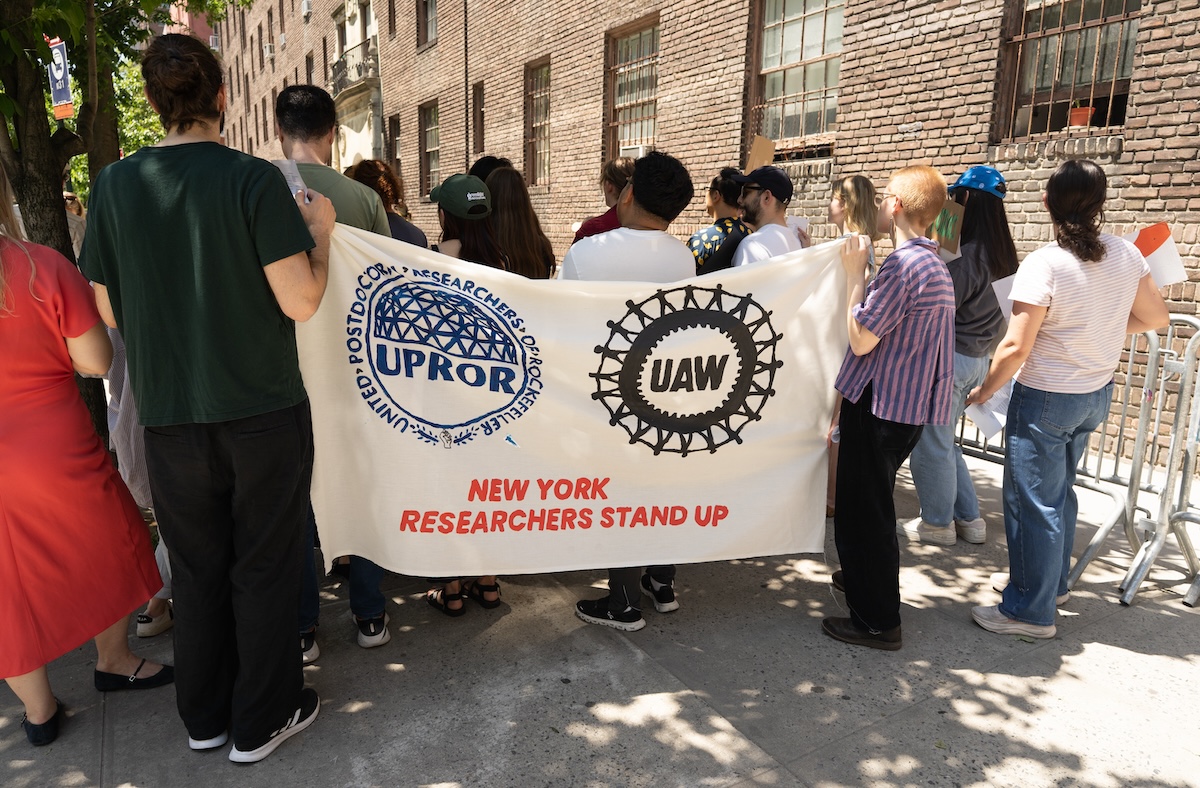
On May 20, Rockefeller postdocs and allies from Weill Cornell participated in a day of action with hundreds of unionized researchers across the city
On Tuesday, May 26th, we held our 30th bargaining session with the University. We proposed updated counters on Grievance and Arbitration, Prohibition Against Discrimination, Harassment, and Retaliation, and Union Rights and Access. While Rockefeller continued to push back against important provisions in all of these articles, we were able to reach a Tentative Agreement on Union Rights and Access after the session. This important article ensures that we have access to the information and areas of our workplace needed to enforce our contract.
Toward the end of the session, we also had our first discussion regarding economics. The University described the Union’s proposals as “exorbitant”, and repeatedly argued that the proposals were unrealistic in light of federal science funding cuts and Rockefeller’s current financial concerns. They have told us they will not even engage with our proposals at the bargaining table – an unacceptable proposition.
Rockefeller reiterated many of these points in an email on May 28, after sending a previous email on May 6. Despite claiming to be an attempt at keeping postdocs “informed,” both emails leave out important factual information in ways that seem intended to mislead postdocs on the current status of bargaining. We have requested that the University explain their estimates of the cost of our proposal (which disagree with our own estimates) and elaborate on their vague gestures towards financial concerns, but the University has not responded to our requests.
As the bargaining committee represents all postdocs at Rockefeller, we are committed to working tirelessly towards a fair contract that ensures the rights and economic improvements we deserve. We urge the Rockefeller administration to acknowledge the urgency of these improvements by engaging with our proposals and agreeing to basic protections and economic improvements that are essential for an inclusive, equitable, and competitive workplace. We trust that our postdoc colleagues will continue to follow the negotiations closely and attend upcoming bargaining sessions to see the process firsthand.
Read below for an overview of what Rockefeller left out of their most recent email.
What Rockefeller Says vs. What They Leave Out
| What Rockefeller Says | What They Leave Out |
|---|---|
|
”…[T]he union’s negotiating committee has proposed an exorbitant package of economic demands which are far out of step with the collective bargaining agreements (“CBA”) that postdocs represented by the same union agreed to earlier at Mt. Sinai and Weill-Cornell. Until now, the union has repeatedly claimed it is looking to the Mt. Sinai and Weill-Cornell agreements as precedent for the Rockefeller agreement.” |
It is true that we regularly reference Mount Sinai and Weill Cornell – because Rockefeller has repeatedly proposed language and standards that fall below those same contracts. There is no reason for Rockefeller to provide fewer rights and protections than its peers, which costs them nothing. But using Mt. Sinai and Weill Cornell as benchmarks for non-economic provisions does not mean their contracts should serve as a cap on salaries, benefits, or other economic terms. |
|
“Rockefeller already provides a salary and benefits package that is comparable to—and in most cases substantially better than—those offered by peer institutions. Despite this, the union is demanding contract terms that are far beyond industry norms and would be economically irresponsible, including more than a 27% increase to the postdoctoral minimum salary, more than a 44% increase to the research associate minimum salary, and major expansions to healthcare, retirement, and other benefits that exceed the generous benefits Rockefeller already provides and is well above the agreements the union itself accepted at Weill Cornell and Mount Sinai.” |
Our proposed percentage increases to minimums are comparable to the percentage increases achieved at both Weill Cornell and Mount Sinai. These agreements additionally contain large compensation increases with experience, something Rockefeller does not provide. This makes the difference from those institutes even more pronounced. See the chart below for a comparison of negotiated wage increases from Mount Sinai, Weill Cornell Medicine, and Columbia. Our numbers are not arbitrary demands. They are matched to the federal General Schedule for the New York City area, which provides locality-adjusted pay scales for doctoral-level research positions. We provided a reasonable initial proposal, and Rockefeller’s framing of these proposals as “exorbitant” and “out of step” is a disingenuous attempt to undervalue the work of postdocs, which has long been undercompensated relative to our value and expertise. |
|
“The union’s demands, if enacted, would impose extraordinary new costs on the University and its laboratories at a time of growing financial stress and uncertainty across biomedical research institutions nationwide.” |
While many of us are funded by federal research funding, other institutions with greater dependency on these sources and significantly harsher financial difficulties, like Weill Cornell, have been able to agree to and sustain significant economic improvements on par with what we are proposing. |
|
“We proposed that the parties should meet for three days in a row in July in marathon sessions… It is customary to meet to bargain for back-to-back days as parties near the end of negotiations, particularly for a first contract. The University proposed that the union meet with us on July 14, 15 and 16 or July 21, 22 and 23. The union, so far, has not agreed to meet on either of those back-to-back days.” |
Rockefeller has refused to schedule any sessions between May and July 14, meaning we will be unable to bargain with them for nearly two months this summer, by which point we will have been negotiating for 16 months. Bargaining on consecutive days can be useful in the end stages of bargaining, when there are fewer outstanding items remaining on the table. However, with many significant economic and non-economic issues still unresolved, we need consistent sessions to make meaningful progress while maintaining regular consultation with Unit Members. Since Rockefeller sent their email, we have proposed to the University bargaining for 4 to 5 hour periods on at least 5 additional dates. |
|
“The University remains committed to bargaining in good faith and believes the union must present a more realistic economic proposal to allow us to respond effectively to move the negotiations forward. We, and the other members of our committee and the University, remain committed to pursuing a fair and responsible resolution and will continue to keep you informed as negotiations progress.” |
Rockefeller hopes we will bargain against ourselves. Our proposals are the product of extensive conversations with postdocs and research associates, careful analysis of peer institutions and compensation benchmarks, and more than a year of feedback from Unit Members. Throughout bargaining, we have repeatedly explained that our role is to bring Unit Members’ priorities to the table. When Rockefeller dismisses these proposals as “unrealistic” without meaningfully engaging with them, it is outright dismissing the voices of the researchers who identified these needs and asked us to fight for them. |
| Mount Sinai (2023) | WCM (2025) | Rockefeller Postdocs (2026) | Rockefeller Research Associate (2026) | |
|---|---|---|---|---|
| Salary minimum pre contract | $58,661 | $61,008 | $72,100 | $75,000 |
| Salary minimum immediately post contract | $72,500 | $74,692 | $91,808 (proposed by UPROR on 05/11/2026) | $108,997 (proposed by UPROR on 05/11/2026) |
| % increase | 24% | 22% | 27% | 44% |
Additionally, note that Sinai and Weill Cornell’s contracts include increases that account for experience, lifting their compensation further above that of Rockefeller postdocs.
If you have any questions about our ongoing negotiations or thoughts on how to encourage greater urgency from the Rockefeller administration to reach agreement on a strong first contract, please do not hesitate to reach out.
In solidarity,
Joanna Krzyśpiak
On behalf of the UPROR-UAW Bargaining Committee
Tentative Agreement:
UPROR-UAW Proposals:
Prohibition Against Discrimination, Harassment, and Retaliation
University Proposals: